
Europe’s extremism problem

© AP Photo/Andreea Alexandru
“This is a crisis of political meaning, across Europe, a familiar pattern is hardening into something more troubling: Young voters are drifting toward political extremes.
Governing coalitions are stunned by (or collapsing under) the weight of public distrust. Center-left and center-right parties — long the anchors of postwar stability — are struggling to explain what they stand for or why they deserve another chance.
In this environment, anger is easier to mobilize than confidence and certainty — however false — travels faster than reform.
The recent U.S. National Security Strategy describes this as a lack of “civilizational self-confidence,” but that framing misses the deeper problem. What Europe is experiencing is a crisis of political meaning. Where leadership offers little more than technocratic management, voters seek conviction elsewhere. Where mainstream parties appear afraid to name trade-offs or defend first principles, extremes step in to do it for them.
The results are visible across the continent. In Germany, a far-right party is polling at historic highs, reshaping the political landscape and constraining the governing coalition. In Poland and Hungary, illiberal movements have shown how quickly democratic norms can erode once they consolidate power. In France, President Emmanuel Macron’s centrism — even though it pushed through some long-overdue reforms against “the street” — has given rise to radical forces. Standing for “neither left nor right” eventually risks standing for nothing at all.
Even where instability appears procedural rather than ideological, the signal is the same. Repeated government collapses, caretaker administrations and snap elections—such as those now looming again in Bulgaria — feed the perception that democracy is stuck in neutral. Over time, frustration curdles into openness toward alternatives that promise clarity, order or disruption.
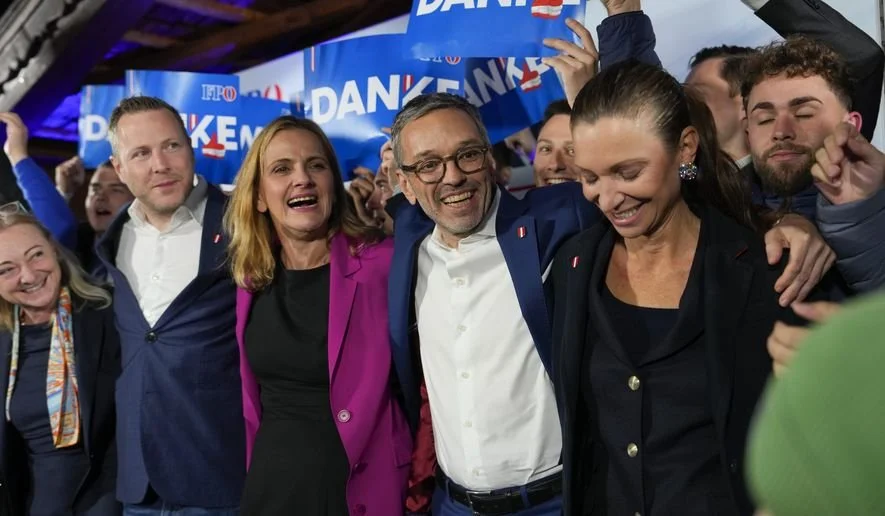
Austria — my home country, and one where I have been active in politics for just the past year — offers a revealing case. In its September 2024 national election, a far-right party emerged as the largest bloc in parliament, posting its strongest showing since 1945. Coalition arrangements have so far kept it from power, but the direction of travel is unmistakable. The next election could prove decisive, making Austria one of the most important countries to watch in Europe.
Austria’s history gives this shift particular weight. Since the defeat and banning of Nazism after World War II, Austria — like much of Europe — has lived with an implicit understanding about the boundaries of acceptable politics. Those boundaries, however, are not self-enforcing. In periods of prolonged uncertainty, unresolved questions of identity and responsibility tend to resurface — often in modernized and electorally palatable forms.
What is happening now is not a sudden rupture, but a slow normalization of forces once kept at the margins.
For the United States, none of this is abstract. Europe’s political drift has direct consequences for American interests. A fragmented, polarized Europe is a weaker partner — less capable of collective action on security, trade, technology or global stability. When European governments are consumed by legitimacy crises at home, transatlantic cooperation becomes harder to sustain.
This concern is sharpened by changing U.S. priorities. President Trump’s recent assertion that Europe is no longer a linchpin of U.S. security and foreign policy interests — whether meant as provocation or policy — reflects a broader American recalibration. The assumption of permanent U.S. leadership and attention can no longer be taken for granted.
And yet, Europe still needs the United States. Militarily, economically and diplomatically, the transatlantic relationship remains indispensable. The challenge ahead is not disengagement, but adaptation: sustaining a productive partnership in an era of greater distance, fewer guarantees and higher expectations on both sides.
This is where Europe’s missing reformers matter most. The choice is not between a hollow center and an angry fringe. It is whether new voices can emerge that are willing to confront hard truths, defend democratic institutions without sounding defensive, and offer a credible vision that speaks to voters who feel adrift. Decline is a choice, not destiny. A return to growth and increasing prosperity may be hard, but is achievable. Without that, the extremes will continue to set the terms.
Europe’s elections are sending clear signals. They reflect a continent searching for direction—and testing its options. For Americans, the lesson is simple: Europe’s political health is not a side story. It is a bellwether for the kind of partner the United States will face in the years ahead.
Veit Dengler is a member of the Austrian Parliament for the province of Styria.